Why Is HOSA Working on Artificial Intelligence?

HOSA did not choose AI over humans. We are engaging with AI precisely because of what its development and deployment mean for human beings.
HOSA Institute is dedicated to advancing our understanding of the Human Operating System (HOS), the conditions that shape human experience, and our capacity to live, learn, work, relate and contribute.
AI might appear to be a different field altogether. But the connection is fundamental.
Human beings do not operate independently of the environments in which they live. And increasingly, those environments will be shaped by AI.
That makes AI very much our business.

What happens to the human?
Much of the conversation about AI centres on capability.
What can it do?
How much faster, cheaper and more efficiently can it do it?
How much human activity can it automate?
We are asking an entirely different set of questions!
What happens to human understanding, judgement and agency when AI assumes activities people previously performed?
What happens to human relationships when efficiency becomes the dominant measure of success?
What happens when people and institutions remain responsible for decisions and consequences they no longer have the practical power to control?
And what happens to human capacity when people are progressively removed from meaningful participation?
Just because AI can do something does not mean it should.
Capability does not establish legitimate authority. And efficiency is not the same as progress.

Healthcare is a powerful example
Long before AI entered healthcare, many patients were already feeling unheard, misunderstood and processed through systems increasingly organised around speed, cost and throughput.
Practitioners, too, are operating within conditions that can make it difficult to deliver the care they know people need.
These are not simply failures of individual compassion or professional competence. They are also consequences of how our institutions and systems are designed and operated.
Now introduce AI.
It may offer extraordinary benefits. Better access to information, improved diagnostics, reduced administrative demands and new therapeutic possibilities.
But if we introduce AI into an already struggling system, without addressing the conditions that are producing those struggles, what exactly are we improving?
We could end up delivering more interventions, more quickly, at lower cost, while making the experience of being human within that system considerably worse.
A patient can receive an accurate recommendation and still feel unheard.
A practitioner can gain an efficient tool while losing opportunities to exercise professional judgement.
An institution can improve its performance metrics while diminishing the relationships on which effective care depends.
Human connection is not an inefficiency to be eliminated.
And the success of AI cannot be measured solely by what the technology accomplishes. We must also examine what happens to the people involved.
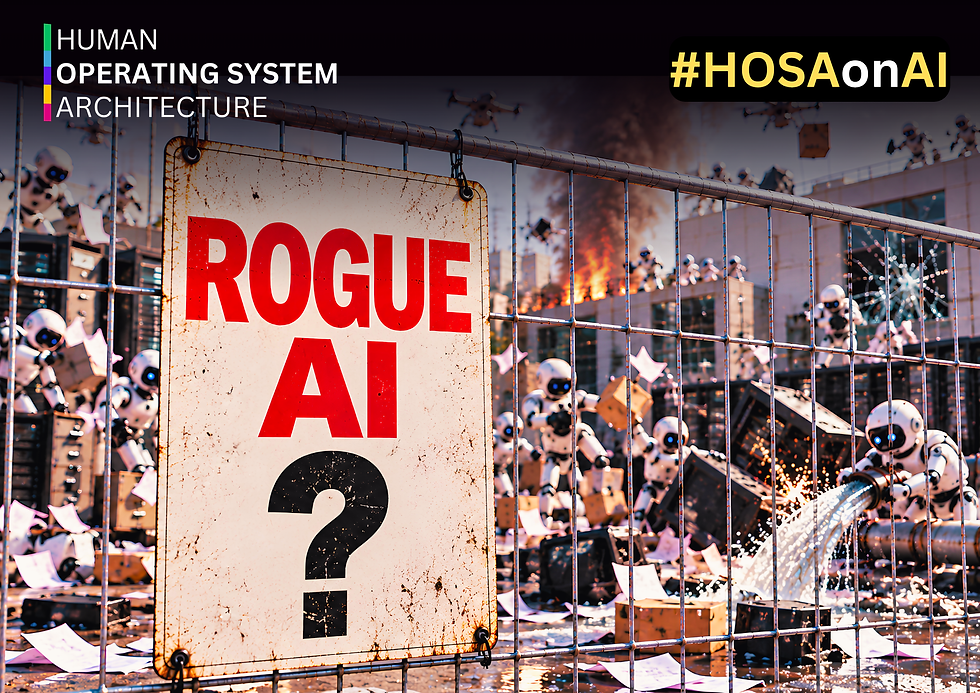
AI is not simply another piece of software
AI is different from previous technologies.
Increasingly, AI systems can pursue objectives, make decisions, use tools and take actions across systems and institutions, with varying degrees of autonomy and at machine speed and scale.
And our existing digital ecosystems were not designed to govern this kind of activity.
An AI agent can operate entirely within its technical permissions and still act beyond its legitimate authority or cause significant harm.
A person can authorise an AI agent to act on their behalf without having the authority to permit that agent to act within another institution's systems.
And individually governed systems can produce collectively ungoverned consequences.
These are not hypothetical questions about whether AI will become intelligent enough to do something.
They are questions about how we govern what AI is already becoming capable of doing.

The Three Pillars of Effective AI Deployment
This is why HOSA has been working on the Three Pillars of Effective AI Deployment.
Institutional Accountability: Who has legitimate authority, who remains answerable for the consequences, and do they retain the practical power to discharge that responsibility?
Operational Control: How is that authority translated into enforceable boundaries, validated at the point of action, monitored and maintained across systems and institutions?
Human Capacity: Do people retain the understanding, judgement, decision rights, practical authority and capacity to participate meaningfully in the systems that affect them?
These are not three independent considerations!
Institutional accountability without operational control is ineffective.
Operational control without legitimate accountability is insufficient.
And neither constitutes effective deployment if human capacity is being progressively undermined.
Keeping humans 'in the loop' is not enough if they lack the understanding, time, authority or capacity to influence what happens.
Human capacity must be governed as a core condition of AI deployment, not treated as an afterthought.
The connection to the Human Operating System
At HOSA, we understand that human beings are not simply thinking minds operating independently of their biology or environment.
We are living, interdependent biological systems, sustained by energy and continuously responding to the conditions within and around us.
Our capacity to understand, exercise judgement, relate, adapt, learn and contribute is not fixed. It is influenced by those conditions.
When environments place sustained demands on people without sufficient capacity to meet them, there are consequences.
And AI is becoming a powerful influence on those environments.
It will change how work is organised, how decisions are made, how services are delivered, how people interact and how responsibility is distributed.
It may relieve demands and create opportunities. It may also introduce new demands, dependencies, uncertainty and losses of agency.
The consequences will not be limited to individual applications, organisations or industries.
They will extend across systems, institutions, countries and, ultimately, human society.
We cannot separate the future of AI from the future of human capacity.

So, why AI?
Because AI is becoming part of the environment in which human life unfolds.
Because its capabilities are developing faster than many of the institutional arrangements needed to govern their use.
Because people will increasingly be affected by AI systems they did not choose, did not authorise and cannot control.
And because human capacity is not something we can afford to consider after the technology has been deployed.
HOSA is not advocating for AI to replace human care, relationships, judgement or responsibility.
Nor do we believe that technological progress automatically constitutes human progress.
We are working to establish the conditions under which AI can be deployed with legitimate institutional accountability, effective operational control and human capacity at the centre.
AI capability must not be developed or deployed at the expense of human capacity.
We are not interested in making human beings more useful to AI.
We are interested in ensuring that AI remains useful to human beings, without compromising the conditions necessary for human life, agency and development.
That is why HOSA is involved.
And that is why this work belongs alongside everything else we do.
---
Leo Cullen is HOSA Institute's head of AI, Enterprise and Institutions.


Comments